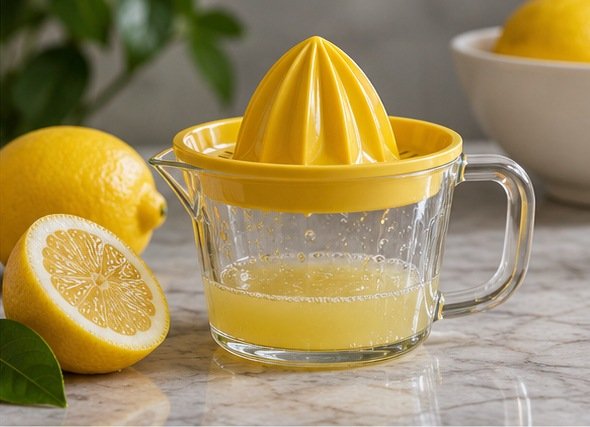
Choose a manual citrus juicer for the fruit and volume you squeeze most. A handheld press is handy for a lemon or lime at dinner. A reamer over a collecting cup makes it easier to capture and pour several portions. For larger oranges or repeated batches, check whether a wider cone or supported lever fits your counter and how long it takes to clean afterward. A tool that fits your fruit is easier to use than a general-purpose model that requires several squeezes per half.
Check the fruit size first
Measure a typical lemon, lime, or orange at its widest point. Compare it with the usable bowl on a press or the cone and collection area on a reamer. A large half that sits above the bowl can slip or produce uneven pressure. A lime on a broad, shallow cone can be difficult to grip and rotate. Use the actual fit rather than relying on a decorative photo. Check whether a device sold for lemons also accepts the oranges you buy or whether a second head is supplied.
Different batches of the same fruit can vary in size. Keep a little room for imperfect halves and think about how you normally cut them. Follow the instructions for orientation and operation. Some handheld presses invert the fruit relative to the way you might expect, while a reamer depends on direct contact between the cut face and its ridges. If you frequently switch between fruit sizes, compare the hassle of swapping inserts with the benefit of a closer fit across both sizes. OXO's two-in-one juicer is one example with different reamers for different fruit.
Compare presses, reamers, and countertop levers
A hinged handheld press uses both hands or one sufficiently strong grip, depending on design. It directs juice through openings and can be convenient over a pan or bowl. Check the handle span at the start of the squeeze. It might open farther than your hand can comfortably manage. Look for enough room around the pivot and read how the maker expects you to hold the tool. A narrow press fits small fruit but can also require emptying and reloading for each half.
A traditional reamer can be used over a separate vessel or supplied with a strainer and cup. It uses pressure and rotation, so counter grip and hand position matter. A large cup can rest steadily on the worktop if its base stays planted. A countertop lever uses a taller frame in order to apply pressure downward. Measure it with the arm raised and the cup in place. A broad footprint may be justified for frequent batches, while a lighter rimmed reamer can fit a drawer and be ready quickly for a single recipe.
Decide how much pulp and seed control you need
Look for a strainer you can reach and clear easily. Small openings capture more pulp and seeds, but they can clog as you repeat a batch. A coarse basket can leave more pulp in the cup. Check whether the model offers an adjustable or removable insert and whether you can rinse it quickly. If you need particularly clear juice for a dressing or drink, a separate fine strainer may be useful. Compare the effort of using one with the space and care required by a model with several interlocking parts.
Check whether you want to pour immediately or measure the juice. A clear cup with readable markings helps when a recipe uses specified volumes. A small lip or well-shaped spout can help control a thin stream when you pour from a broad container. Look at whether the top can be removed without dripping over the counter. If you want to squeeze directly into a bowl, check that the openings and handle position let you direct liquid into it without using the rim as a support point.
Plan hand position and countertop space
Try the motions you expect to repeat, such as holding a fruit half while twisting a reamer or placing each half into a press. A long handle can fit a whole hand but may occupy more space in a drawer. A countertop stand can reduce the effort required to squeeze, yet the gripping position may be too tall when it sits on your normal counter. Check the angle of the lever at the beginning and through the rest of the movement. Compare whether your free hand can place a vessel without reaching around a moving arm.
A freestanding model needs a level stable surface and clear access. Use it as directed. Check whether mounting or setup steps are needed and whether moving it is realistic once you finish. A small manual device is easier to tuck away if its parts remain together. If there is no convenient place to store a tall frame assembled, decide whether the time it saves during a batch compensates for getting it out and putting it back.
Look at cleanup and replacement pieces
Read which components can go in a dishwasher and where they fit. Citrus pulp can settle around slots, ridges, and hinge areas. A removable cone and strainer are useful when you can rinse them and put them together easily. Inspect seams and ask how the handle or hinge should be maintained. If you can remove the cup but not the cone, check whether the surfaces left on the frame are reachable using the maker's directions.
Make a sample recipe, then watch what you have to wash. If you switched to a separate measuring cup anyway, consider whether the collecting cup's markings were necessary. If you only make one glass and reassemble a large tool from several pieces, a smaller style may be more practical. For larger batches, see whether you can clear pulp without disturbing the collected juice. Store the dry pieces together according to instructions so the smallest insert doesn't disappear before you need it again.
Compare a cup-style juicer with a simple press
If you mainly add a little acid to a sauce, a small press can sit beside the cutting board and send juice straight into the pan. For several glasses or a batch of marinade, a larger collection cup reduces interruptions. Set out the containers you use and see whether the juicer's base and spout can work beside them. A wide cup can occupy more counter area than expected once the fruit and scraps need a place too.
Check the volume you can collect before the juice touches the strainer. A large measurement mark alone won't tell you the useful batching point. If you plan to refrigerate the result, transfer it to a suitable storage container and wash the juicing assembly promptly. Choose the handling sequence you are more likely to repeat when cooking, rather than the design you would only get out for an occasional specialty recipe.
Related guide: Read the companion buying guide.
Reference: See the source and specifications.
Frequently asked questions
Is a handheld press suitable for oranges?
Some are large enough and designed for them. Measure the fruit and the bowl and check the manufacturer's size guidance.
Can I use a lemon juicer with grapefruits?
Many compact models are too small. A wider reamer or a product specifically intended for large citrus gives the fruit better support.
Should I choose a model with a measuring cup?
It is useful if you regularly juice for recipes. For quick squeezes over a pan, a press with easy aim and cleanup may suit the task better.