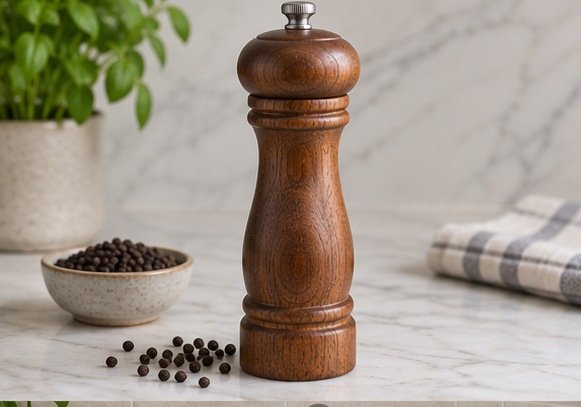
Choose a pepper mill with an adjustment you can read, a grip you can turn easily, and a refill opening you can reach without dismantling awkward parts. If you grind just a little over dinner, output per turn may matter less than control. If you use it while cooking several meals, compare how many easy turns it takes for a usual batch. Check the ingredients and cleaning instructions for the model before deciding on its size or finish.
Decide which grinds you actually use
Compare how you use pepper in soups, sauces, and on finished food. A finer result can blend into a mixture, while a coarser result can leave a distinct texture. The labels on mills aren't standardized, so compare what comes out rather than assuming that two middle settings yield the same pieces. For frequent switching, choose a clear mechanism that lets you return to a known point. If you stay at one setting, ease of cleaning and the overall grip may matter more than an extensive range.
Look for examples of the resulting grind or see whether you can inspect a sample. Some differences are easier to notice on a white plate. Use the same type of peppercorn in both mills when comparing at home if the manuals allow it. Think about whether you want the particles to look even or just want a familiar distribution for the dish. One coarse test and one fine test can tell you how much useful separation the adjustment offers. A range of numbers offers little benefit if adjacent settings are hard to distinguish in normal cooking.
Compare adjustment at the top or base
A twist knob on top can make adjustment simple to reach. Check whether it also holds the head together, and whether removing it for filling resets your setting. A base dial can make choices easy to identify when the marks are visible and the mill stays steady in your hand. The instructions for the Peugeot Paris u'Select mill illustrate a model-specific adjustment approach. Get the actual manual so you can identify the intended direction and stops, and avoid treating extra tightening as a normal way to change the grind.
Consider what you'll do when the surface is greasy or the mill has been used several times. A broad, readable adjustment ring may be easier to move than a shiny knob with little grip. See how many separate steps are involved in setting it and then using the main twist. Some mills use indexed choices while others permit adjustment across a wider range. A fixed stop can be convenient for shared use if another person wants to return to a particular grind. Choose the control that suits the differences you really use.
Check the grip and stability
Hold a similar-sized cylinder as if you were turning the top over a dish. A tall body can give both hands separate places to sit. A short model can be easy to put down between steps and may fit a crowded spice shelf. Compare grip diameter and how far your fingers need to travel for each turn. A narrow taper can help one hand stay put, but may be less comfortable if it forces your fingers to the same point repeatedly.
Check where the ground pepper exits. A base that rests on the counter can leave residual particles after use. Some models have lids or trays; others can be stored in a dedicated dry spot following their instructions. If you'd like to hold it over a plate at the table, compare the range of the grind and how easily you can stop at a small quantity. A high-output mill can save time at the stove but feel less precise for small servings. Give that use more priority if you mostly season after cooking.
Make refilling straightforward
Check the opening and how the body opens. Top-fill designs can be convenient if you can hold them steady and pour directly. Other arrangements might require separating the top or turning the mill over. Observe whether loose pieces need a clean place to rest and how you can tell when the chamber is full. A clear window can show remaining peppercorns, though a small window might not be visible from its spot on a shelf. Compare capacity with how often you need to fill it. A high volume isn't useful if most of it sits unused for long periods.
Confirm what ingredients the mill is designed to handle. A similar-looking salt or spice mill can have different materials and use limits. Only use peppercorns and sizes supported by the maker, especially if you prefer blended products. Follow directions for clearing the mechanism rather than rinsing components or grinding another product to remove particles. Store refills somewhere easy to find and keep a way to identify the contents if you use separate mills side by side.
Compare one meal and one refill
Use a familiar dish to observe the ease of getting both a little pepper and the larger amount you sometimes need. Then refill it independently of cooking. A helpful design should not require you to clear an entire countertop to add more pepper. Watch whether you lose your place on the grind dial when you remove a lid. If the base collects residue, review the approved cleaning steps and decide whether you can keep the storage spot tidy.
If possible, let another member of the household change the grind and return it. Two people may use different settings and still benefit from a clear dial. Make sure the widest part fits the shelf and that its height allows you to lift it over nearby objects. Compare the replacement parts or service guidance before buying a second matching mill. Everyday usefulness comes from the combination of control, fit, and ease of daily care.
Check how the mill moves between stove and table
If one mill handles both cooking and serving, you may want a form that stands steadily on a tray but still gives you an easy grip above a pot. Check the path from the shelf to the work surface. A narrow-necked design can require more time to refill, while a large body can occupy the shelf space you wanted to preserve for other seasonings. Compare it with an empty container of about the same size before buying. Work out which side is easiest to hold and whether you can turn it over your most common cookware without contacting a hot surface.
For a shared table, place and remove the mill as you would during a meal. Check whether a different adjustment can be understood without instructions and whether you can identify the contents from normal seating distance. A sticker on the shelf or a distinct shape can be helpful when separate mills look similar. Leave the mechanism set in a position you actually use, following the maker's guidance.
Related guide: Read the companion buying guide.
Reference: See the source and specifications.
Frequently asked questions
Is a taller pepper mill better?
A tall mill can offer a longer grip and more capacity. Compare the diameter, balance, refill design and space available to store it.
Do all pepper mills accept blended peppercorns?
Check allowed ingredients and sizes for the exact mechanism. Similar mills can have different limits.
Should I buy a variable grind mill?
An adjustment is helpful if different foods call for different textures. If you use one setting almost exclusively, prioritize a comfortable grip and convenient refill.