Choose a salad spinner around the amount of greens you wash at once and where the tool will live between meals. Pump models suit repeated one-handed use at a counter. A smaller crank model can be easy to store if you only prepare a few handfuls of leaves. Give the basket, lid, and drainage route as much attention as the mechanism. Those are the parts you handle on every use, even when the advertised spin speed is impressive.
Find the right working capacity
Start with a typical bowl of greens in your kitchen. Compare its volume to the spinner's basket rather than taking the capacity on the box at face value. Some listings describe the outer bowl, which is larger than the basket. Leaves need room to settle and redistribute. A compact basket is convenient if you normally wash a handful for sandwiches or dinner for one, while a wide basket can reduce separate batches when you bring home large heads of lettuce.
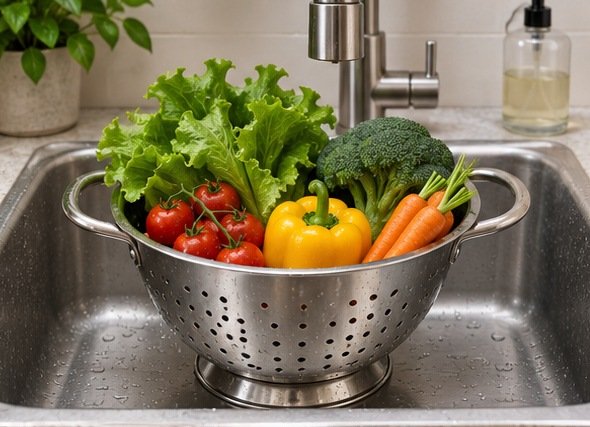
If your household uses delicate greens, consider splitting a large wash into smaller batches that don't compact them. If you wash herbs as well as lettuce, check the size of the basket openings so small leaves don't work through. A basket that is useful as a colander should have a sturdy rim and feet or useful clearance above the sink if that's where you plan to drain it. Measure its height and diameter rather than guessing from a serving photo.
Compare pump, crank, and pull drives
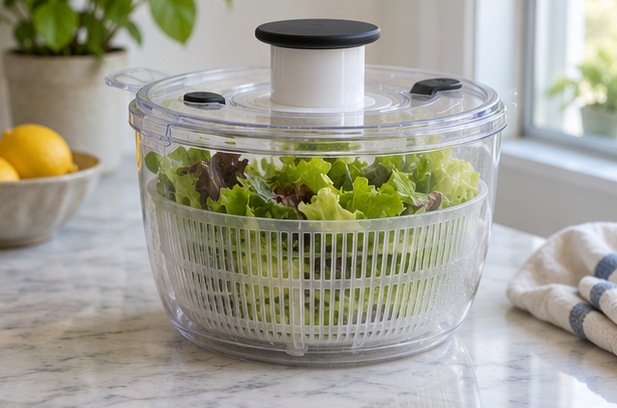
A pump design uses repeated downward pushes and often gives the other hand room to steady the unit. A spring-loaded pump can stick up in storage, so look for a lock that keeps it down if the model has one. A brake helps the basket stop before you lift the lid. OXO's spinner illustrates that pump and brake arrangement. Confirm how a particular brake feels and where it sits if you expect to use it with a wet hand.
Crank styles use a twisting motion and may offer a low lid profile. Look at how far the handle must sweep and whether your free hand has a flat area to brace. Pull-cord styles can be a practical option when the counter provides horizontal clearance. Compare how easy the grip is to hold and whether there are instructions for cleaning around the cord opening. The drive that feels easiest over a series of batches is often more helpful than the design that looks simplest in a catalog.
Examine the base and how it drains
Look for a stable base with enough contact to keep the bowl planted independently of the lid. A non-slip rim can help on a dry countertop, but check whether water pools under it and whether it can dry quickly after rinsing. If you use the spinner next to the sink, consider the edge and where the lid opens. Keep enough room so you can lift the basket straight up and transfer it without tilting it over the counter.
Drainage can come from lifting the basket and pouring out the bowl, or from a dedicated opening if one is included. See how the outer bowl handles a pour. A broad lip and comfortable handholds can make a big difference when it is full of water. If you work over a shallow sink, a removable basket you can set down while you pour may be more convenient than any built-in drain. Decide where you will put the wet lid between batches before checking whether the bowl doubles as a serving dish.
Check care instructions and lid access
Read which pieces are dishwasher-safe and where the manufacturer says to place them. A dishwasher-safe basket can still take up most of a rack, so measure its height against the clearance above the upper rack. If the lid separates for cleaning, check whether the clips are obvious and if the lid can be put back together without tools. If it does not separate, look for a clear way to rinse crevices without wetting internal parts that should stay dry.
A translucent bowl makes it easy to see collected water. A metal bowl may be attractive if you intend to serve from it, but the usefulness of the basket and lid remains the priority. Check whether replacement baskets or lids can be ordered. A missing or cracked part can take an otherwise useful bowl out of rotation as a spinner. If it fights for space with mixing bowls, measure whether the parts nest and whether the drive can be locked for storage.
Walk through a typical prep session
Put a chopping board, serving bowl, and colander in their normal positions. Next, decide where the spinner would go when it is wet and open. This quick exercise reveals how much counter area you have for real work. A small spinner used twice may fit your routine better than a wide one that needs both the sink and the only clear prep surface. If you often wash greens for a group, a wide basket can justify its footprint if you can drain and refill it without moving other things out of the way.
After using a new unit, check whether the basket is balanced and the lid remains seated. If the bowl moves, test a smaller load before assuming you need to replace it. Transfer leaves after spinning and allow all components to dry as directed before closing them up. Keep the basket and lid with the bowl so it can come out of the cupboard as a complete tool. If the spinner sits unused because setup takes too long, try a lower shelf and a simple routine for serving directly after washing.
Consider a short and a tall storage position
Measure your proposed shelf with the door closed and note its clear opening. The lid of a pump spinner may sit low when locked, while models with a fixed crank have a permanent high point. Decide whether you plan to stack a light item inside or on top only as the maker allows. If the bowl will hold other equipment during storage, choose something you can lift out in one trip so the spinner doesn't become a hassle to reach.
Compare how clear the lid is from above and whether you can see its alignment without tilting the wet bowl. A lid that goes on the same way each time can be easier to operate while preparing several dishes at once.
Related guide: Read the companion buying guide.
Reference: See the source and specifications.
Frequently asked questions
Can a salad spinner take the place of washing greens?
Use washing instructions appropriate to the produce you have. The spinner removes excess water after washing, so check package directions first when using bagged greens.
Is a large spinner better for a household of two?
It depends on the dishes and batch size. Two people who make several salads at once can use the extra room. A smaller unit can be easier to store and clean for occasional meals.
Do I need a brake?
A brake makes it easier to stop without waiting for the basket to coast. It is useful for repeated batches, but a simple spinner can work well if you wait for it to stop before opening.
Can it also store salad?
Check whether the outer bowl and lid are designed for storage. Follow appropriate food handling guidance and use a storage container that fits the quantity of greens.