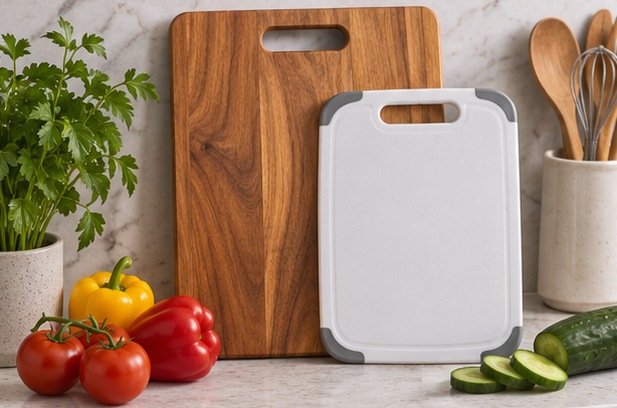
Choose a cutting board large enough for your ingredients and small enough to clean comfortably in your own sink. A substantial board makes sense if it can stay on the countertop. A light, dishwasher-compatible board can be easier to move and wash during a busy meal. Choose the size and cleanup routine before deciding between wood and plastic. Both materials can work for household prep when you follow the care instructions and keep boards in usable condition.
Measure the working area and cleanup path
Measure the clear space on the counter with your usual equipment in position. Leave room for the handle of your knife, a bowl, and a place for ingredients waiting to be cut. Try a paper rectangle of the listed dimensions before choosing. A board that appears compact in a photograph may project over a narrow countertop or cover the only space where you can set down a hot pan. If you cut long vegetables, check the working diagonal as well as the width.
Use the same dimensions to check the sink. A broad board that must be cleaned at an angle can send rinse water across the counter. If you intend to use the dishwasher, confirm both the material guidance and the height between racks. A board that fits with the higher rack raised may be inconvenient if you must change the rack for each load. For a board that will be stored vertically, check whether it fits through the cabinet opening and can dry fully before you slide it into place.
Compare wood and plastic by handling and care
Wood can offer a substantial, stable surface and a finish that suits a permanent countertop location. Check how the maker wants it cleaned and dried, and whether its finish needs periodic treatment. Glued constructions may have different care limits from a single piece of wood. The USDA discussion of wood and plastic boards distinguishes solid hardwood from laminated boards in relation to dishwasher use. Use that context alongside the instructions for your exact board. Avoid assuming that all boards of the same material can tolerate the same wash cycle.
Plastic boards are often lighter at a similar footprint and may come in several colors for organizing different tasks. Check thickness and stiffness if you intend to carry chopped ingredients across the kitchen. A thin flexible sheet can make transfer easy, but it can lift or shift during prep if it does not sit flat. A rigid plastic board adds stability if its feet and shape hold firmly. Look for clear rules on cleaning and replace a board when wear makes its surface difficult to clean thoroughly.
Decide whether a groove or reversible face helps
A perimeter groove can catch liquid when slicing juicy fruit or carving. It occupies some of the usable surface and can leave a knife tip close to the edge when working in a hurry. Check how the internal groove dimensions compare with the size of food you often cut. A deep channel also needs room for a brush or another appropriate cleaning method. If you mostly chop dry foods, a plain face can give you more uninterrupted room for long cuts and make it easier to sweep ingredients into a bowl.
A reversible board can provide a grooved side and a flat side, or simply offer another clean working face after washing. Feet on one side can reduce this flexibility. Check whether the unused face will sit level when you turn it over, and consider where it rests while the other face is in use. Two separate boards can simplify a workflow where one is reserved for raw animal foods and the other for produce or ready-to-eat ingredients. Choose a label or shape that lets everyone in the household identify the right board.
Check grip, weight, and edge shape
Set the board where you'll stand and look for rocking or sliding before cutting. Built-in grippy feet can help when they make reliable contact with a clean, level surface. A narrow frame along the perimeter takes up some working space, so study the inner dimensions if you buy a small board. If the model has a handhold, check that it doesn't interrupt the area where you pick up the cut ingredients. A shallow cutout under the edge can be useful when a large board is hard to grip flat on the counter.
Weigh the trade-off between stability and carrying. A heavy board may feel secure under a knife but awkward when you lift it to wash or transfer ingredients. A large handle or two handholds can help when you can use both hands. If the board will stay in place, think about how you will clean underneath it and where you can put it when you need all the counter space. If it moves between several homes or cooking stations, a lighter, rigid model may be handier than a large block.
Plan for more than one prep task
Sketch a normal dinner with produce, something juicy, and ingredients that need separate handling. Decide the preparation order and where each board goes once it has been used. You may find that one large board and one smaller, easily washed board offer more flexibility than an assortment of equally small boards. Keep the smaller one accessible if you do quick snacks on a narrow counter, and reserve the largest for preparation that needs room to stage several ingredients.
After the first use, check where you want to set a bowl and how you rotate the board to clean both faces. Leave room to dry the board completely as directed. Notice whether the kitchen layout leads you to use the same corner for every task. If so, maintaining a clear grip and cutting surface there matters more than features on the far side. Keep a simple care routine near the place where everyone cleans up instead of relying on memory for different finishes.
Compare two sizes before buying a set
A small board that goes easily into the sink can be the everyday choice for fruit and sandwiches. A wider board may be useful for preparing several ingredients where volume makes loose pieces spill over a smaller edge. If you buy them together, check whether both surfaces are substantial enough for the jobs you assign. Some boxed sets include a very small piece you may rarely use.
Try putting your largest mixing bowl beside the larger board template and opening any nearby drawer. For a shared kitchen, ask another cook to use the other side or position. Those simple checks are helpful when the cutting area is used by somebody with a different reach or knife preference. A board that can be approached from either end is more versatile when countertop space changes from one meal to the next.
Related guide: Read the companion buying guide.
Reference: See the source and specifications.
Frequently asked questions
Is a thick board always more stable?
Thickness can add weight, but a flat base and good contact with the work surface matter too. Check that the board does not rock when you press near each corner.
Do I need a separate board for raw meat?
Using a separate board for raw meat, poultry, or seafood can simplify food handling. Keep it distinguishable from a board you use for produce and ready-to-eat ingredients, and clean both appropriately.
Can I use the stated dimensions as working dimensions?
Check whether the listing includes handles, edge trim, or a juice groove. The clear cutting area can be smaller than the outside dimensions.
When should I replace a board?
Inspect the surface and structure. Deep wear, cracks, or damage that makes the board hard to clean or keep steady can make replacement worthwhile.