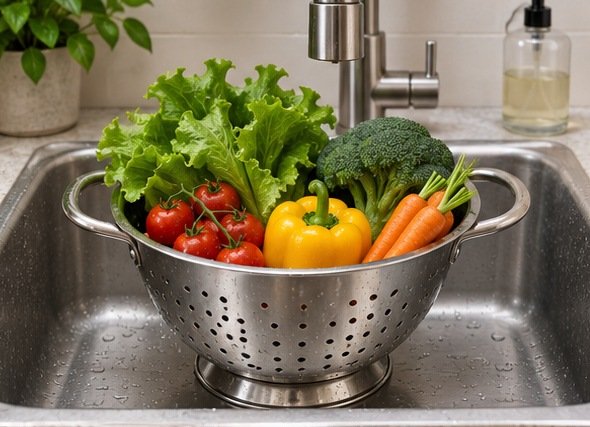
Choose a colander that holds your usual batch and stands securely where you need to drain it. Larger, widely distributed holes suit many pasta shapes, while smaller openings help retain fine ingredients. Before comparing finishes, measure the sink, the inside of the bowl, and how far the handles stick out. Good access is especially important if you need both hands to handle a separate pot.
Start with the batch size
Use your normal pot or serving bowl to estimate the largest batch you regularly drain. An advertised capacity can describe volume close to the rim. Leave room to tip in the contents without crowding them and to move the colander without pinning ingredients against the edge. A small household may benefit more from a medium bowl that fits well in the sink than a large model that must be held at an angle each time.
Consider types of food as well as volume. Long pasta occupies space differently from a pile of greens. A broad bottom can spread produce for rinsing, while a deep shape can keep a batch contained. Try placing a similar bowl in the space where you intend to drain. Make sure you have a convenient area to put it down afterward. A second small strainer might be worthwhile for single portions or tiny ingredients if the main bowl would be awkward to handle for those jobs.
Compare hole size and placement
Look where openings continue toward the bottom and sides. Holes across more of the surface can let liquid escape as the bowl fills, while a solid outer rim may help keep food inside when moving. Inspect how the bottom drains when the colander sits flat. Some models carry most holes at the base, which may suit a shallow batch and drain differently when heavily loaded. A hole pattern that looks generous in a photo can still leave a pool if the lowest area is solid.
Match the openings to the smallest items you plan to rinse. Tiny grains and small seeds may require fine mesh. Pasta and larger produce often fit a more open perforated design. If you use mesh frequently, check how easy it is to dislodge stuck particles and whether the edge and wire are protected. A rigid perforated bowl can be quick to clean after larger pieces, while a fine sieve takes care of jobs a colander wasn't intended to do. Buying both is useful only if those jobs happen often.
Measure the sink, feet, and handles
Measure width and depth lower inside the sink, where the bowl and feet will rest, instead of using only the countertop opening. Sinks may narrow at the bottom and have a drain or raised feature in the center. Give the bowl room to stand without rocking or blocking the natural drain path. OXO's stainless colander is an example with a supported base and side handles. See how far the feet raise the bottom and where the handles sit in relation to your sink edge.
Check the exterior width including handles. You should be able to reach and support them according to the directions without turning the colander through a tight corner. For an over-sink model, measure the exact span and ledges it requires. Verify the instructions for supporting the filled bowl and the surface on either edge. A freestanding model may be better if your sink does not provide reliable mounting points. Use the arrangement that lets all pieces stay stable while you handle them.
Consider stainless, plastic, and collapsible styles
Stainless steel can be durable and feels rigid in a large model. Check how the maker describes handling and care. A polished bowl can show water spots, and handles without separate grips can feel different when the bowl is used with hot contents. Plastic may be lighter, but verify that it suits each temperature and cleaning method you expect. A plastic colander bought for rinsing berries may have different limits from one designed for draining cooked food.
Collapsible designs can save cupboard space. Compare the folded height and the shape of the rim, then check how it supports the contents and how the seams should be washed. A fold in the bowl can change where food or water rests. If you have a tall cabinet but limited width, look at how both rigid and folding models can stand on the shelf. One rigid colander may nest inside a useful bowl and require little additional space when stored according to instructions.
Walk through draining and prep
Picture your ordinary sequence from the cooking surface to the sink and back to the serving area. Follow the cookware and colander instructions for handling hot food and liquid. Keep the sink and route clear, and compare where the colander should sit so you can tip the pot from a stable position. If the method would require balancing a full container or holding your body at an awkward reach, change the layout or choose a more suitable tool.
For produce, check how water flows through when you add a shallow layer. Then try transferring the rinsed food to the surface where you prepare it. A colander removes excess rinse water, while a salad spinner may be useful for leafy greens when you want to remove more surface moisture. If you already have a removable basket that does this job well, buy a colander for whatever isn't covered, such as a larger shape, smaller holes, or a more stable stand.
Check cleanup and long-term storage
Look at where perforations meet the rim and feet. Some parts have recesses where small food pieces collect. If you wash it by hand, verify which brushes or materials the manufacturer allows. If it goes in the dishwasher, check the height with handles included and think about where it can dry fully. A convenient storage spot should let you pick up the colander without shifting a tall stack of dishes.
Test one normal batch and one smaller batch after purchase. Verify that the bowl is supported, that food stays inside, and that there is room to lift it where you normally stand. Check the rim for rough spots and follow the seller's process if you find a problem before use. Keep it near the sink if you use it daily, and leave the larger shelf space for cookware you actually need on the counter.
Think about the smallest servings
A large colander can drain one portion, but a small batch can spread into hard-to-reach areas. If you often rinse a handful of berries or drain a single serving, see whether the bowl can sit close to the preparation area and whether you can pour the food into a smaller dish without spilling it. For a household whose servings vary widely, compare the largest model that nests appropriately with a small compatible strainer before buying two nearly identical sizes.
Related guide: Read the companion buying guide.
Reference: See the source and specifications.
Frequently asked questions
Is a fine mesh sieve the same as a colander?
They can overlap, but mesh is handy for smaller ingredients and a perforated colander can be easier for larger batches such as pasta and vegetables.
What should I measure first?
Check the inside of the sink and the space for the handles. Compare the usable bowl volume with your normal food batch.
Do I need feet?
Feet can keep a freestanding colander above a surface and leave a drainage gap. Check placement and stability for the exact design.