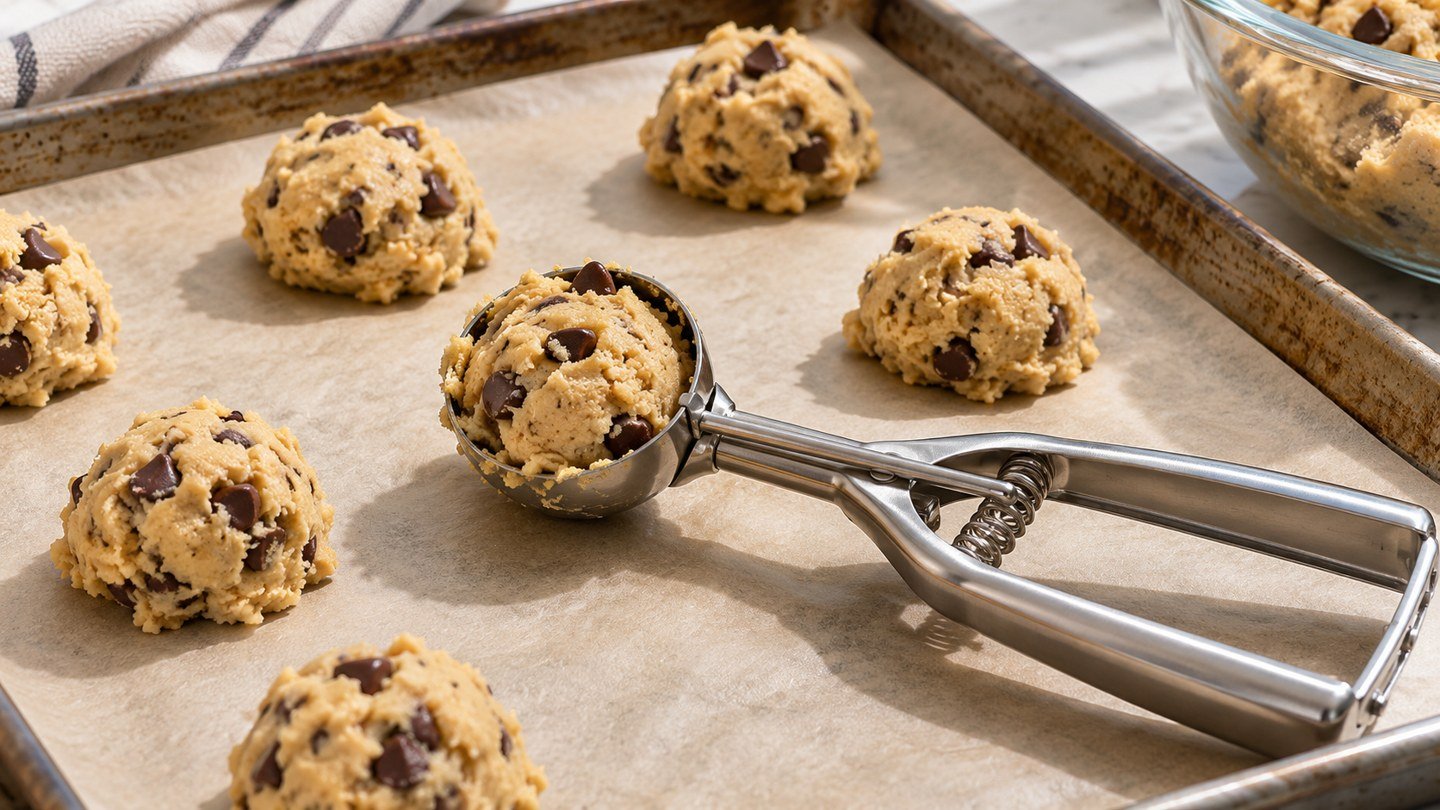
A cookie scoop makes repeated portions easier to transfer from the mixing bowl to the tray. Choose it for the amount of dough in each cookie and the firmness of the dough when you portion it.
Match capacity to your recipes
A scoop number alone tells you little if you are comparing listings with different labeling conventions. Look for volume in tablespoons or milliliters and compare it with the portion your recipe specifies. For a recipe that lists a total dough weight and the number of cookies, divide the weight and test one weighed portion before you settle on the scoop. Chunky inclusions can change how neatly a dough packs into the bowl.
Compare the release mechanisms
Some scoops have a thumb lever, while others release when you squeeze both handles. Check which motion feels comfortable with the hand you use to portion. If you usually work from a deep bowl, look at whether the handle opens freely against the rim. A scraper that travels cleanly across the bowl can help with tacky dough, but the design still needs to suit the resistance of the mixture.
Check assembly and maintenance
Look for an intact joint at the handle, a release blade that stays aligned, and cleaning instructions for the spring and pivot. Dough can dry into the joints, so remove residue after use. If you typically chill dough until very firm, follow the manufacturer’s guidance about dough firmness and avoid forcing a scoop that binds.
Try a tray before buying several sizes
Portion three cookies onto a sheet and weigh them if repeatability matters. Record the scoop, dough temperature, and whether you leveled the top. Use the result to decide whether you need a second size or a small adjustment in how full you fill the same scoop.
Frequently asked questions
Is a larger scoop always faster?
It can reduce the number of scoops for a recipe that calls for large cookies. If you use it to half-fill smaller portions, repeatability can be harder to achieve.
Related buying guide: Read the companion guide.