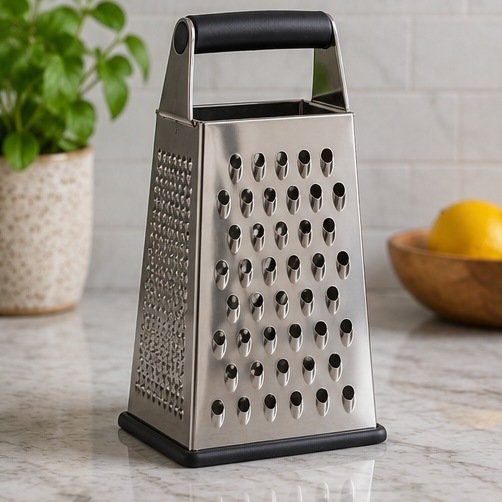
Choose a box grater for the ingredients you grate most. A wide coarse face handles piles of cheese or vegetables comfortably, while a fine face helps with smaller quantities. Look for a handle you can hold securely and a base that sits flat on the surface you use. A collection cup can be helpful for measured recipes, provided it leaves room for the finished food to fall and is easy to remove.
Decide which cuts you really need
Start with a list of typical jobs. Firm cheddar for a family meal, carrots for a salad, and a little zest each call for a different cut. Look at the openings and their arrangement. A coarse face with a clear path for a large carrot may be more useful than a grater with extra panels but little usable space on each one. For small quantities, a narrow fine face may be sufficient. If you already own a fine handheld grater, give more weight to the work that you expect the box model to take over.
Compare coarse, medium, and fine output in photographs showing actual ingredients, when available. What manufacturers call medium can vary. Some faces produce longer shreds, while others cut smaller pieces. A slicing face can be useful when it accommodates the food safely under the maker's instructions. If you frequently need flat uniform slices across broad vegetables, compare the section's real capacity with the tool you already use for those jobs. Choose the box for its most useful two or three surfaces.
Measure the working face and handle clearance
Check the width and length of the grating section independently of the overall height. A tall frame can have a substantial handle or a section below the face that does little cutting. Sketch the size of the food and the stroke you can make without bumping a countertop or a backsplash. For a large batch, long repeatable strokes can be helpful. For a shallow counter, a compact face can be easier to reach from a safe position.
Handle design matters because your other hand is guiding food. Try the grip from the position you expect to use it. Look for comfortable clearance above the body, especially if your fingers are large or if you hold it through several portions. A horizontal handle can help you orient the face. A grip that rotates or compresses may feel different when you steady it. The grater should stay stable in its intended position and should not rely on an unapproved support that can tip or slide when pressing.
Assess the base and collection cup
Set or imagine the base on a known flat work surface. Some products have a removable non-slip band. Check whether it covers the whole edge, how it fits after cleaning, and whether it stays in place without an additional step. A base that grips securely on the manufacturer's recommended surface helps you focus on the cut. If you usually grate into a bowl, check whether the maker supports that position and whether there is room to keep both pieces steady.
OXO's box grater illustrates a design with several faces and a collection container. A cup gives the shreds somewhere to go and can make measuring easier. Verify whether the markings are readable and whether it becomes crowded under a large batch. Consider how you empty the container and whether it can be put back without clearing the whole counter. When a grated ingredient is sticky, a full cup may also contact the bottom of the grater. Try a typical portion shortly after purchase, following the care and use guidance for the product.
Compare cleaning and storage
Look at how the inside corners meet and whether you can rinse around seams without handling sharp areas. Read the exact directions for detergents, brushes and dishwasher placement. A grater that goes into a dishwasher still needs a stable place where it cannot interfere with other items. Check whether its base, cup, and any lid have different care requirements. Trapped scraps near a removable base can make a tool harder to maintain, so access matters as much as the finish.
Use the manufacturer's suggestions to protect the cutting faces and your hands while putting the grater away. A tall box may not fit upright under a shallow shelf. If you store it horizontally, avoid leaving exposed cutting surfaces where someone could touch them reaching for other tools. Store the cup with the box if the shape allows it. Keep parts dry and look for damage or looseness before bringing the tool back into regular use. If the grater is often buried behind several heavy appliances, move it to a reachable place before deciding that the design is inconvenient.
Try one batch that represents your normal cooking
Choose a usual ingredient and portion rather than the smallest item in the drawer. Notice the usable length of each pass, whether output collects where you want it, and how the frame feels when you turn it to the neighboring panel. Follow the handling instructions, and use any suitable protective accessory the maker specifies. Stop when a piece of food is too small to hold safely. A sturdy tool with the right face and access will make the usual grouping of tasks feel straightforward.
Time cleanup separately. If a small recipe would still be faster with an existing hand tool, reserve the larger grater for batches where a stable base and wide face are valuable. If the collection cup remains empty because you always grate onto an appropriate separate surface, don't give it much weight when comparing replacements. The best buy follows your regular prep work, including where you put the grated ingredient immediately afterward.
Compare interchangeability with tools you own
Set the box beside the utensils you currently use for similar jobs. If you already use an appropriate zester for small quantities, a wider coarse panel may matter more than the fine face. If you bring a tool straight from the cupboard to the table for an occasional garnish, consider whether the full box has a stable, practical place there. The same grater can suit long prep at a counter while being needlessly awkward for a short task elsewhere.
Look at the way you store and transfer cheese or vegetables. A detachable container can be easier to lift if the portion you use is small, and a larger receptacle can reduce interruptions for bulk preparation. Check the shelf or refrigerator dimensions before counting a container as useful for storage, and follow its guidance. Think about whether both hands will be available when you move the parts. Compare a typical setup and cleanup side by side before you choose among competing features.
Related guide: Read the companion buying guide.
Reference: See the source and specifications.
Frequently asked questions
Do I need four cutting faces?
Choose the faces you actually use. A wide coarse face and practical fine section can matter more than features you rarely need.
Can I grate directly into a bowl?
Check the grater's instructions and choose a supported stable arrangement. A flat base or compatible cup may suit your workflow better.
Is a bigger grater always more useful?
Only if it provides better working area and you can use, wash and store it comfortably. Measure the true cutting face separately.