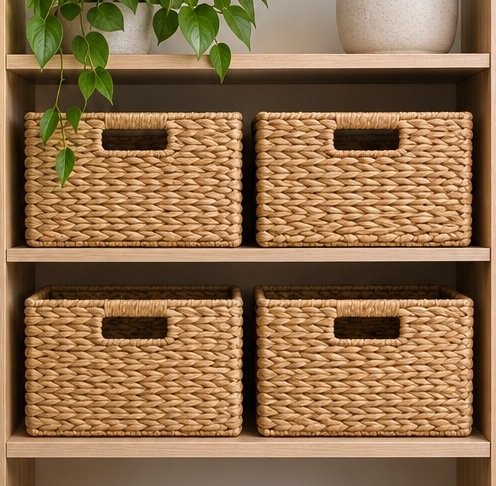
Choose storage baskets with enough room for your everyday items and enough clearance to lift or pull them off the shelf. Take measurements with the products in their normal storage position and allow space for your hand above or in front. A shallow basket can be easier to use on a high shelf. A deeper one is useful for bulky items if you can safely reach and support the full load.
Start with the objects that need to stay together
Group your things by what you retrieve at the same time. A basket for a set of bathroom linens has a different useful shape from one for small desk accessories. Measure the longest and widest item in the orientation you want to keep. Then try grasping it with similar items on both sides. A large basket that makes you dig each time may benefit from a smaller inner container or a shallower format that keeps the top layer visible.
Choose what doesn't belong in the basket as well. Heavy items may be better left on suitable low support, depending on the shelving and basket guidance. Delicate components can snag in some woven walls. Items used every day should have a position where you can retrieve and return them without clearing other shelves. If you plan to label categories, use a label you can read from the way you approach the shelf. Make clear whether a basket holds one project or a general group to avoid needing to sort it twice.
Measure the shelf and loading path
Measure internal width, usable depth, and height at several points. The front opening can be smaller than the interior, especially where trim or uprights project. Allow room to grasp the handle and turn it if the shelf sits beside a wall. A flexible basket may still need enough internal clearance to keep it from catching. Check how far you have to lift it before a lip clears. If you already own a basket that works well, measure both its outside and its useful compartment size.
Look at the inside bottom and the top opening separately. Tapered walls can make the floor narrower than the lid or rim. A basket that fits by outer width may not hold flat objects you want to place at the bottom. For a stack of towels, compare the width you actually fold to. Put a cardboard template on the shelf and check overhead space with the shelf at its usual height. Check manufacturer guidance and don't load a shelf or basket beyond what is supported.
Compare woven, fabric and rigid styles
Woven baskets can feel firm or flexible, depending on material and construction. Inspect whether the weave can catch a soft item and whether a liner is useful for the particular storage. IKEA's BRANÄS range illustrates one woven format to compare with a specific shelf. Read clean and dry instructions for your exact model. If you use it in a damp setting, verify whether the material is intended for that environment.
Fabric cubes can be light and easy to remove, while rigid bins can protect the shape of the interior when you fill and empty them repeatedly. Compare the bottom support and whether the sides settle outward under load. Open frames or windows can help identify contents but may also leave small items able to protrude. Check what happens if you set the basket on a surface that needs to stay clean. Reusable boxes with simple finishes can simplify upkeep when they are handled many times each week.
Inspect handles and access
Measure for a usable grip when the basket rests between adjacent objects. A cutout handle needs enough space behind it for fingers, while a loop outside the side can add width. If you pull it forward first, check where you can get another supporting hand under it. A larger basket may require two hands even if some product photos show it on one arm. Pick the shape that suits normal loaded use and stays easy to return to its spot.
Think about baskets for several people. An easy-to-read label can help when several units are indistinguishable. A basket with no handle can create a clean front but may require a gap that you would rather use for storage. On a high shelf, arrange the weight and position so it can be handled appropriately. Use approved brackets, shelf placement, and limits. Hardware that supports the shelving matters just as much as the basket's design when bulky items are involved.
Test a single shelf before buying several
Buy one representative basket or compare a sample for fit before filling every shelf. Load it with a normal group of items. Open or remove it several times during ordinary use. See how often objects fall sideways and whether you have a clear place to set the loaded basket when you retrieve something. If you only need something near the front, consider leaving a low open area there rather than taking the entire unit down. After cleaning, fit it back in position with other items already in place.
Leave room for future ordinary additions. An open compartment can collect unassigned objects quickly. A slightly smaller basket can give you a practical visible spot next to it for what needs to stay separate. If several containers share a shelf, pick one with enough width for the items it really needs and keep another shallow if you handle those contents more often. An arrangement succeeds when the item you need can go back in one movement, even on a busy day.
Sketch what the open shelf looks like when a basket is missing
A frequently used basket may spend part of the day away from its slot. Consider whether the surrounding pieces remain supported and whether there is space to set the basket down while you work. If the basket is used in a different room, measure that second spot too. The most convenient handle for pulling straight out can be awkward when you carry the same load down a narrow passage. Test the real route instead of assuming a basket only needs to fit on its shelf.
Compare whether a set of identical bins will help with future changes. It can look orderly and give you room to exchange positions. On the other hand, a row of equally deep bins may make lighter items or frequently used objects harder to see. Try one shallow basket near the shelf opening if you repeatedly need to reach into it. Leave the deeper one for bulky things that go in and out as a group.
Check the label's readability against the shelf height. A small tag may work at eye level and disappear on the lowest shelf. Before you buy more, look at which items stay out because putting them back takes too much effort. Use that observation to refine the choice.
Related guide: Read the companion buying guide.
Reference: See the source and specifications.
Frequently asked questions
Should a basket fill the whole shelf?
Leave space for the handle, lifting and nearby hardware. A modest gap can make everyday use easier.
Are fabric cubes strong enough?
Check the load and dimensions of the exact model. Compare bottom support and side movement under a representative load.
Should all baskets match?
A matching group can be convenient, but choose shape and fit first. The same shelf may have jobs that call for different widths or depths.