The Dutch oven you reach for most often should hold your usual batch, fit the burner you actually use, and feel manageable when full. Start with the recipe that sends you shopping for one. A pot for weeknight beans has different demands from a pot for braising a whole roast or baking a tall loaf. Compare capacity alongside the flat cooking surface, rim height, and weight. A larger quart number alone won't tell you whether the pan is well suited to your kitchen.
Choose the size by working volume and base width
Look up your usual batch size and allow room to stir, pour, or add ingredients. The quoted capacity often describes the volume of the vessel close to the rim. A pot you fill that far will be awkward to lift or stir. Consider the largest batch you make regularly instead of the largest one you can imagine, especially if the pot needs to live in a narrow cabinet. For smaller households that want leftovers for several days, a moderately sized model often gives better daily access than a large one purchased mainly for occasional gatherings.
Ask for the inside flat diameter where food will brown. Deep sides can add volume without providing a wider bottom. A wide base gives separated pieces more space in a batch, while a narrow base may require more rounds of cooking. An unusually broad model can also leave a larger portion of the base beyond a small burner. For a choice between similarly sized models, compare the actual recipes, burner dimensions, and cooking surface before deciding which dimensions benefit you.
Compare round and oval shapes on your own equipment
A round model is straightforward to match to a circular burner and is usually easy to turn in the oven. An oval model may fit longer cuts with less need to trim or rearrange them. Put the exterior dimensions on paper and consider where the burner sits underneath. Check whether its flat footprint matches your cooktop's stated cookware guidance. If two burners are often occupied, measure whether this pot's handles project over the pan next door.
Measure the oven rack and clearance above it with the lid and knob included. Also check the route through the oven door. A pot that fits with the rack extended may feel different when you have to keep it level and reach in with mitts. If a recipe requires removing the lid later, confirm you can reach the handle safely and have a suitable spot to set a hot lid. If you bake bread, compare the inside dimensions with the loaf you expect and read the pot manufacturer's guidance before using a preheat routine.
Check weight, handles, and lid together
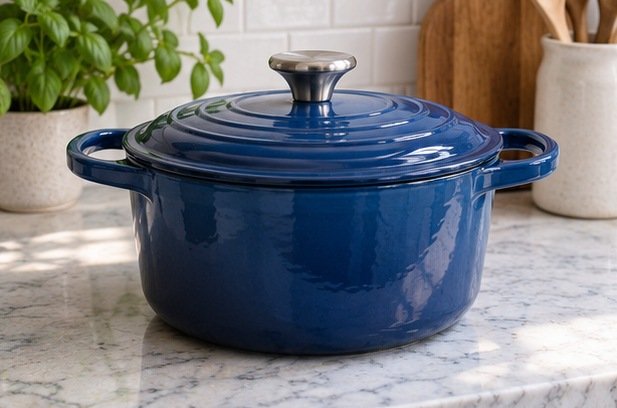
Compare empty weight with the lid on. Add the weight of your usual meal to get a rough idea of how the pot will feel when you move it. Two broad loop handles make it easier to grip with thick mitts if they offer enough finger clearance. Check whether the handles are level or tipped up and whether their shape feels stable during a two-handed carry. If lifting heavy cookware is difficult for you, choose a smaller pot or compare a lighter construction designed for the same recipes.
Look at the lid handle as a separate part. Some knobs have a lower oven temperature limit than the rest of the cookware. Find the limit for the exact model and configuration, including any replacement knob you plan to buy. A broad knob can be easy to lift in mitts, but a low-profile part may let the pot fit a crowded oven. Check whether the lid settles securely on the rim and is easy to place without accidentally knocking the edge against the pot.
Understand enamel finishes and cleanup
A light interior can make it easier to see browning and spots that need cleaning. A dark interior may make stains less visible, and its texture can feel different under a spoon. Whatever the color, follow the manual for cooking tools, cleaning products, and heat limits. Lodge's enamel care instructions give an example of model-specific guidance worth reading before you buy. Avoid assuming that a cleaning method for bare cast iron applies to an enamel finish.
Check the rim and lid on delivery. Look for damage and contact the seller about any cracks or chips before using the pot. Plan to let cookware cool according to its instructions before washing and avoid rough storage that knocks enamel against other pans. If the lid and pot will stack with other items, use the maker's recommended protection. Leave enough space to put the pot away without sliding a heavy stack forward every time.
Decide whether one pot can replace a task you repeat
Put your most frequent cooking jobs in order. If you mainly simmer soups and dislike lifting them to serve, a lighter stockpot may solve more of your daily problem. If you start on the stovetop and regularly move food into the oven, an oven-compatible Dutch oven can reduce the need for a separate baking dish. If you cook a small quantity of food most nights, measure a smaller model and ask whether it can handle the meal you actually eat when you are short on time.
Think through cleanup and storage for the size you are considering. Plot the route from the oven to an appropriate trivet, then from the counter to the sink when the pot is cool. Compare the pot with the basin so you can rinse it comfortably. If another person in the household cooks, ask them to try the grip as well. Good sizing should make all the ordinary steps straightforward, including the last one when the pot needs to go back on the shelf.
Compare what comes with the pot
Check whether the listing includes the lid shown in its photographs and whether the given weight is for both pieces. Look up the replacement knob and the warranty instructions before choosing based on an unfamiliar finish or limited-run color. A commonly available part may matter if the pot will see regular oven use.
If you cook mostly on a glass surface, check the maker's handling guidance and assess how securely you can lift and set the pot down without sliding it. At the store, test your usual mitts against the handle openings if you can. Knuckle space can differ materially even on pots whose capacities and outside widths look almost identical. Keep the manual for the exact item where you can consult it the first time a recipe calls for a different temperature.
Related guide: Read the companion buying guide.
Reference: See the source and specifications.
Frequently asked questions
Can an enameled Dutch oven work on induction?
Check both the cookware and the cooktop documentation. Compatibility, minimum base diameter, and placement matter for the exact model.
Should I buy an oval pot for braising?
An oval can suit long cuts and crowded interiors. A round pot may match your burner better and is often simpler to use for everyday batches. Compare both against your specific burner and oven.
Are all Dutch oven lids oven-safe to the same temperature?
Check the pot, lid, and knob limits in the manual. The least heat-tolerant piece sets the relevant limit when you use them together.
How do I choose between two similar sizes?
Prioritize working volume, flat cooking diameter, and loaded weight. Confirm the handles and lid fit the storage and cooking spaces where you'll use them.