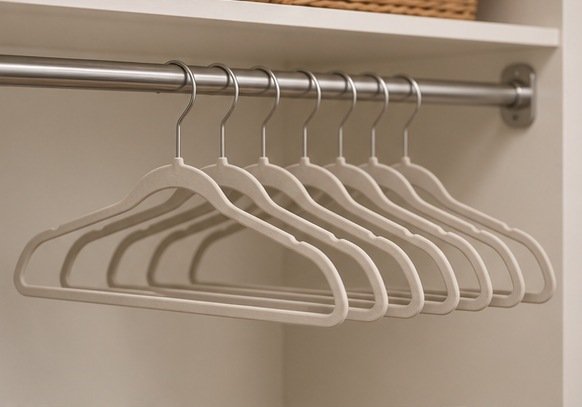
Choose a slim hanger for light clothes when rail space is limited and clothing stays secure on it. Keep a broader shape where you need to support a jacket or structured shoulder. Check the rail and the closet depth before buying a set. Hanger thickness can save room at the hook and still leave a bulky garment pressed against the door if the shoulder width is wrong.
Sort garments by shape and frequency
Start with the clothes you actually take from the closet each week. Separate shirts, light tops, jackets, trousers, and anything you store seasonally. Match shoulder width to the garment rather than using a single external width for all types. If the ends extend too far for a lightweight shirt, the fabric may sit differently. If the hanger is too narrow for a jacket, the shoulder may not have the support you want. Measure a known hanger that works particularly well and keep it as a reference.
For frequently worn garments, compare how quickly you can remove one and return it. A brushed surface can grip slippery straps, but may make a close-fitting fabric awkward to slide on. For garments with straps, check whether the hanger has a smooth hold point at the right position. Check garments' care instructions to decide whether they are best hung or folded. The decision to add rail space should start with suitable garments. Several heavy pieces may be easier to store appropriately elsewhere rather than packing the rail full.
Measure rail and closet depth
Check how much space you have with doors shut. Turn an existing hanger in the direction you expect it to sit and inspect when sleeves press past the door line. Consider clothes shape as well as plastic or wood dimensions. A rail close to the back wall can force broad shoulders to turn sideways. Measure the distance below the rail for long clothes and compare hook height with the hangers you already use. Slightly different hooks can make a long garment touch a lower shelf.
Check the rail diameter or profile against the inside of the hook. If the rod sits high or beneath another shelf, leave room to lift the hook clear. A shallow tilt as you remove a garment may need more height than the hanger shows in a picture. Compare whether the hook turns, stays fixed, or can be aligned in a preferred way. IKEA's BUMERANG page provides a dimensions example for a wooden hanger. Use the listed size as a starting point and measure the clearance with clothing in place.
Compare thin and shaped designs
Slim hangers can leave more gaps between light items. Choose a suitable finish and inspect for exposed seams or edges. When several bulky garments share the space, fabric thickness may set spacing even when each hanger is thin. Divide the number of common items by the usable rail length only after allowing room to move them. Hanging one more piece tightly can make every other piece harder to reach, so leave useful free space in an active section.
Shaped or broad hangers can support an appropriate jacket or blouse with a different shoulder line. Compare a few of them against the closet depth before replacing a full row. A crossbar can work for suitable trousers, but check what happens when the fabric rests on it and whether it sits below a nearby shelf. Clips give another useful approach with some clothing. Check the contact area against the care guidance for the fabric and see how much space the clips need across the bottom.
Look at finish, strength, and storage
Inspect the hook and shoulders. Choose products with supported load and material guidance, especially if outer layers are heavy. Thin metal can be useful for some garments, but don't rely on similar appearance as proof that every hanger supports the same job. Wood and molded plastic can offer different widths and textures. A consistent shape can be convenient for frequent use, though it may make it harder to assign separate functions unless you deliberately reserve some sizes or types.
Leave a reachable place for empty hangers. If they take up rail space between clothes, bundle a few to one side after laundry. Store spare clips or inserts near the garments they support. Check whether replacement hangers can be purchased individually if you prefer a consistent set over time. If the closet has seasonal changes, put a small sample away and make sure you can reach it later without disturbing another clothing group. Space saved on the rail has little value if upkeep adds work after every wash.
Test the new arrangement with a small subset
Try one row of similar garments before buying in bulk. Notice what happens when you reach for something in the middle and return it with the closet nearly full. Check whether hooks move readily along the rod, doors remain clear, and shoulders maintain the intended shape. A few well-spaced hangers can make an active row more comfortable without changing the entire closet. If your problem remains, reassess how many clothes belong on that rail.
Try one familiar jacket or unusual piece separately, even if most of the closet uses a slim style. Draw up a practical count that covers spare hangers while laundry dries. Store seldom-used pieces in a suitable location if they prevent the daily group from moving easily. Choose which hangers are worth buying in multiples based on measured fit rather than matching all visible items at any cost.
Decide whether a bulk pack is a better buy
Start with a small batch of matching hangers for the items that cause the most trouble. If you pick a twenty-piece pack without trying the width, you can make a whole row harder to use. Compare how the fabric sits after hanging for a day and what happens when you remove something from the middle. Observe whether the clip, grip or strap notch is actually helping. Choose more only when the shape works in the same way across several garments you already own.
For a shared closet, set aside a reference hanger for each category. Choose how to tell the spare ones apart without needing to read every size mark. A consistent hook direction may simplify sorting. If one person uses a slimmer rail position, keep a set that fits those shoulders and that closet section. The benefit comes from clear access and appropriate support, so matching everything visually can be a secondary decision.
Check if certain garments take up most of the depth even after you change hangers. Removing a bulky rarely used coat to a suitable storage position can leave more useful space for the clothes you wear today. Take the same measurement after a normal wash and return cycle. That will show whether the set fits practical use with all the active clothing back in place.
Related guide: Read the companion buying guide.
Reference: See the source and specifications.
Frequently asked questions
Should I buy one hanger style for everything?
Sort by garment requirements. Slim hangers can suit light items, while structured clothes may need a wider support profile.
Will thin hangers double closet capacity?
Actual capacity depends on clothing bulk, rail length, and room for access. Compare a representative group first.
What if the closet door does not close?
Check the depth of hanger and clothing together, and whether the rail position or door swing affects useful clearance.