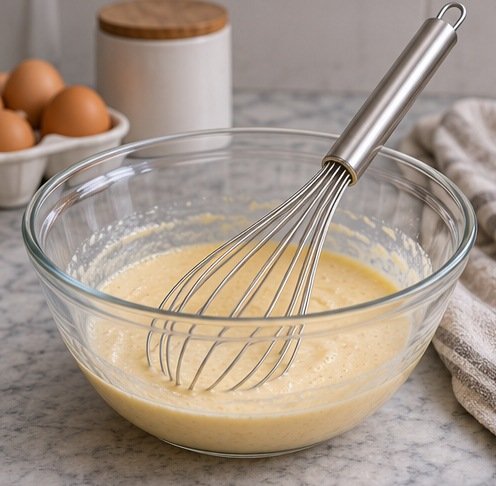
Choose a whisk for the vessel where you use it most. A wide balloon whisk gives you room to sweep through a rounded mixing bowl, while a narrower whisk is often easier to move in a small saucepan or measuring cup. If food tends to collect in the corners of a low pan, look at a flat whisk with an appropriate shape. Handle length and wire stiffness influence the result as much as the name on the package.
Match the head to your most common vessel
Set out the bowl and pan you use most often, then measure the narrowest part where the whisk must move. A whisk advertised by total length may have much of that length in its handle. Check the width of the loops where they actually contact the vessel. Bowl sides can be steep or shallow. Try to picture the movement you make when you mix a small quantity at the bottom instead of using the width of the top opening as your only measurement.
A large balloon shape works well when you want room for broad movements in a mixing bowl. OXO's balloon whisk page is an example of this format. A slimmer shape can get farther down into a narrow cup. Its reduced width can make it easier to sweep along steep sides and leave room for your supporting hand. For a flat pan, a design with lower loops can offer a better approach to the bottom. Work from the location where ingredients need to be moved, then select the head that gets there gracefully.
Look at the ingredients you mix
A whisk that flexes noticeably can be pleasant for a thin vinaigrette but may feel inefficient when stirring something thicker. A firmer loop can help with some batters, within the intended use. Think about whether you need to incorporate air or simply combine ingredients. The tool that gives you easy movement across a sauce pan can operate differently when moved rapidly through a deep bowl. If a dough calls for another tool, use the recipe's method instead of buying stiffer wire to compensate.
Observe what remains unmixed with your present equipment. Dry bits often stick along a corner or wall if the geometry leaves a blind area. A broader set of loops may stir the middle faster without reaching that corner. Check the shape from several angles, then choose the one that can touch the important part of the vessel while you hold the handle comfortably. Compare the actual pattern of loop spacing. Several tightly grouped loops can catch thick mixtures and need different cleaning than a more open head.
Check handle length, grip, and balance
Measure the depth of a usual pan or bowl to see how the handle sits relative to the rim. A short handle can be easy to control in a little bowl but can put your hand close to hot surfaces if your work is in a tall pan. A longer handle adds a little distance while potentially making small movements less natural. Try a similar tool from the position where you stand. If you have a high counter, check wrist angle when the bowl is on it, rather than holding the whisk in the air for a moment.
Some handles are rounded, and others have a profile that indicates the curve of the head. Compare how you can switch hands or rotate the tool between different movements. A soft grip can be useful if it supports your hand and is easy to clean. Inspect any lip where the wires enter. Check that the handle feels stable after cleaning and that you can store it without crushing or bending the head. Keep a predictable place for a tool you use frequently rather than leaving the loops underneath heavy items.
Consider cookware and cleaning requirements
Confirm that the material suits the cookware and cooking temperatures you expect. Bare metal and coated loops can have different use limits. Use the guidance from both the cookware and utensil makers, particularly with a surface that can be marked. If you use a coated whisk, pay attention to the condition of the coating during routine cleaning and follow instructions on replacement. Do not assume all flexible silicone-type tools have identical heat or dishwasher limits.
Read about care before buying a set. A whisk that goes in the dishwasher needs a place where the loops cannot interfere with other items. For hand washing, consider how you rinse near the root of the head and between upper loops. If you use thicker batters, a little more space between wires can make it easier to reach residue. A sealed or smooth handle may be convenient, but follow the manufacturer's directions and let the tool dry fully before putting it away. If the whisk is stored in a crowded drawer, check the maximum head width and height.
Test the shape on two everyday jobs
Try one regular mixing task and one smaller portion. Notice whether the head reaches precisely where you need it and whether the tool pulls ingredients together without unwanted splashing. Check the angle of your grip as you reach across the bowl. If a large balloon head mostly pushes items away from the bottom of a small mug, keep it for the bowl and find another method for the mug. If a side of a saucepan remains hard to reach, consider a narrower or flat design before replacing an otherwise useful whisk.
Compare cleaning and storage while the purchase is still easy to evaluate. A tool you cannot readily rinse or retrieve tends to stay in the drawer. Think about whether an additional size would take over a frequent job or only duplicate the first. If you bake occasionally and mainly make sauces, a compact shape and a suitable material can cover much of the real work. Review what the recipe expects and check whether your choice fits it before adding more accessories.
Decide whether a set is worthwhile
Group your recipes by vessel and action. If two use a large bowl and the others use one saucepan, two deliberately selected shapes can provide more coverage than a multipack of similar loops. Look at the smallest tool in the set first and decide where you would really use it. If an existing fork or other suitable utensil already handles that small quantity, spend the same budget on a more comfortable main whisk. For a shared kitchen, choose which shapes should stay near the normal preparation surfaces and put the least-used pieces farther back.
Look at the whisk between batches
If you pause while other ingredients are prepared, choose where to set the whisk securely. A wide head may need a rest that keeps loops from contacting other items. Compare storage with the exact items you keep near it. For frequently used tools, a few inches of extra space in the drawer can make washing and putting away easier than an unusually long handle. If one shape consistently takes over both of your normal jobs, there is little reason to crowd that space with duplicates.
Related guide: Read the companion buying guide.
Reference: See the source and specifications.
Frequently asked questions
Do I need a balloon whisk and a flat whisk?
Choose by vessel shape and what you mix there. One general whisk can be enough when it moves freely in your common bowls and pans.
How do I choose between metal and coated wires?
Check compatibility with the cookware and use conditions. Then compare stiffness, care and how the head fits the way you stir.
Is the largest whisk always more efficient?
The useful head is the one you can move freely through the ingredients. Measure working width rather than assuming that the biggest model can reach everywhere.