Choose around the way you brew
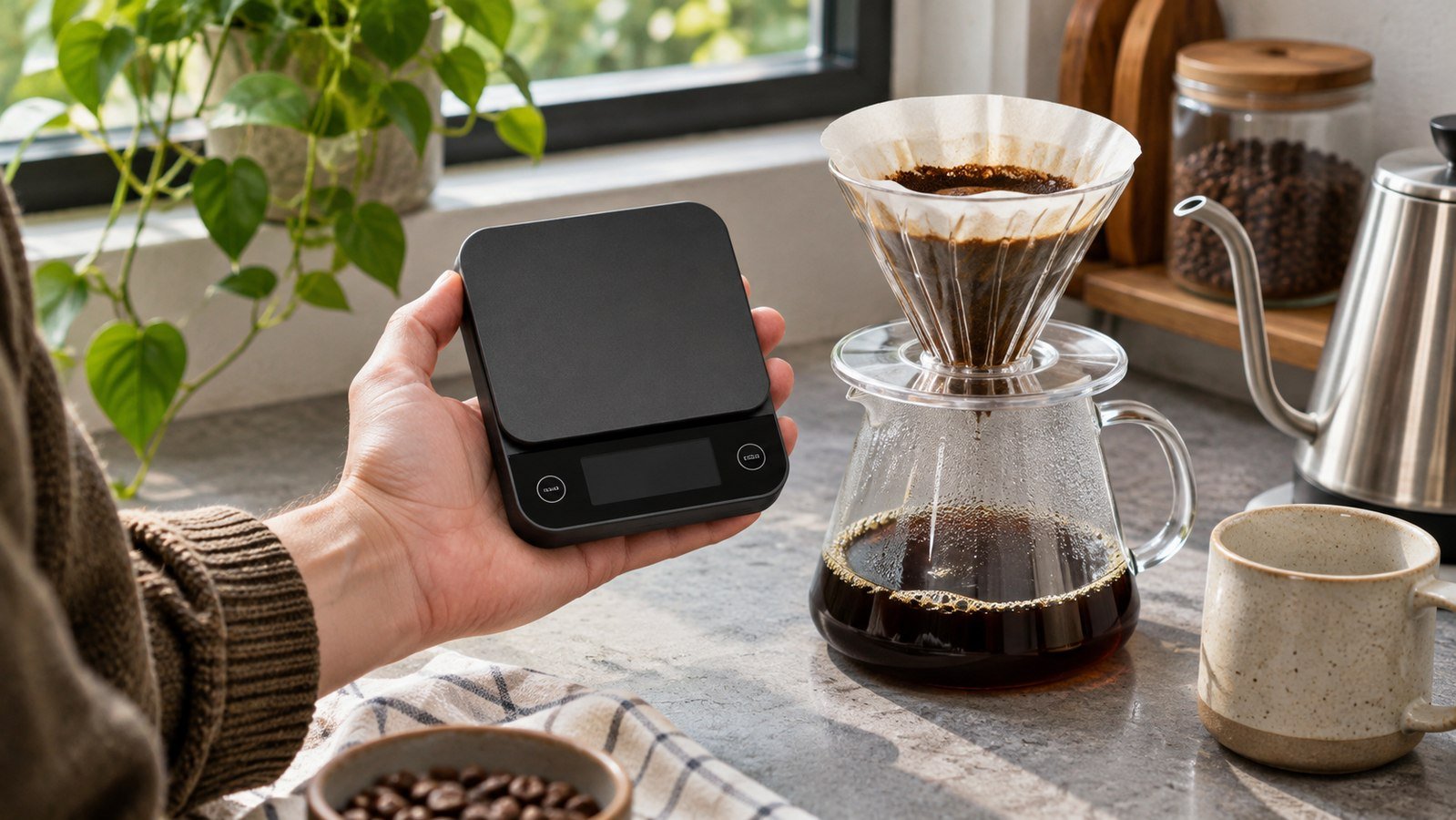
A pour-over scale should make it easy to see the amount of water you add while your brewer and cup stay in position. Start with your kettle, dripper, server, and the recipe you use most. Think about where your hands are during a pour, whether you check the timer, and whether the current scale responds fast enough for you. If your existing kitchen scale shows clear readings in grams and fits the setup, it may already handle most of the work.
Think & Buy reviewed published product information and buying criteria. We did not measure scale accuracy, water resistance, or response time independently. Model comparisons here illustrate features to look up. Use your own setup measurements first and treat brand claims according to the way they were measured.
Compare platform size and total load
Put the server on a sheet of paper and trace its footprint. Compare the base diameter with the scale platform and see whether you can place it fully and securely as the manufacturer directs. Look at how a handle or wide brewer affects the setup. A compact scale may fit the counter and still make a broad carafe awkward to center. A large scale may be easier to read but may interfere with the kettle or other equipment on a small tray.
Include the brewer, server, any accessories, and water when comparing load capacity. Tare resets the displayed reading and does not change the physical weight the scale supports. If you regularly make a larger batch, estimate the total load for that batch rather than comparing the weight of coffee alone. Read any stated restrictions on hot equipment and positioning of the vessel.
Think about increments and response
A display with tenths of a gram can be useful when measuring small coffee doses. It does not establish that every reading is accurate to one tenth of a gram. Ratings can be different at different loads. Check the manufacturer’s published details about resolution or accuracy, especially if you also want the scale for smaller espresso measurements. For water poured into a carafe, usable response and readability may matter more than tiny numerical differences.
Look at how a scale settles after each pour and whether it keeps displaying the last reading while you pause. If you want to follow a recipe by intervals, delayed updates can make it harder to stop pouring near your target. A practical trial is to weigh a familiar item, remove it, and weigh it again under the same setup as directed. If the values differ in a way that matters to your routine, consider whether the surface, unit, or measurement procedure affected the result.
Compare timer controls and visibility
You can time a brew using an integrated timer or a separate phone or kitchen timer. A combined display is useful if both readings are clear from where you stand. The Hario USA V60 Drip Scale listing illustrates a coffee-specific scale category, and the Hario Europe model page provides another reference for the product family. Check the exact manual, especially if you want a dedicated start control rather than automatic timing.
Think through the first seconds of your usual recipe. If you want to start timing at the first contact with water, ask how the controls work before you use the appliance. If a timer starts automatically, review what triggers it and how to reset it. You may prefer a manual timer if the steps in your routine are not consistent from brew to brew. A clear display and few deliberate button presses can be enough.
Consider cleanup and power
Water splashes and coffee grounds are part of some brewing routines. Read the cleaning instructions and check whether the product describes protection around buttons or ports. Keep the device within its documented use. Look at how easy it is to wipe the top and whether a mat, if included, can be cleaned separately. If you store the scale away from the counter, check the thickness and see whether it fits a nearby drawer without pressure on the platform.
Check whether the scale uses replaceable batteries or an integrated rechargeable battery. Consider where you will keep the spare batteries or charger and whether it provides a clear warning before running low. Read the auto-off behavior and think about a brew that includes a long pause. If the device switches itself off before your routine ends, it can be more distracting than using your current scale and a separate timer.
Make one familiar recipe the buying test
Check the delivered price in dollars and add any equipment needed to use the scale in your setup. Compare it with a kitchen scale you already own before paying for coffee-specific controls. If you have a return window, try the same brewer and recipe and compare visibility, fit, and response. Keep the one that makes the brew easier to repeat. An appealing display is less important if the server blocks it.
Our digital kitchen scale guide explains the difference between capacity, display increments, and tare. Our espresso burr grinder guide covers another part of a setup for people who brew more than one way. A scale is useful when it removes guesswork from an actual morning routine.
Test the proposed scale against a whole routine rather than a single reading. Check whether it can show the dry coffee dose, the water poured after taring, and the running time while the brewer is in position. Compare both the placement of the numbers and the angle from which you read them. If you use two different servers, see whether the larger one changes the result. In a shared kitchen, check how easy it is for someone else to reset the controls and move the scale without leaning on the platform. A practical display is an everyday advantage whether or not you use every brewing mode.
Before choosing a new device, compare it with a timer and the digital scale already in your kitchen. Try brewing once with the old setup and identify whether it is the timer, the shape of the platform, or the speed of the display that interrupts you. If nothing interrupts the recipe, you may be able to keep that equipment. If the problem is obvious, look for a feature that specifically addresses it. For example, a separate timer can improve usability without requiring a smaller scale. A differently shaped platform might solve a blocked display even if the advertised precision stays the same. Decide around the problem you can observe.
Frequently asked questions
Do I need a special coffee scale for pour-over?
A compatible kitchen scale and separate timer can be enough. A coffee-specific model may be more useful if you need a smaller platform, a clearer brewing display, or convenient integrated timing.
Does a 0.1-gram display guarantee that accuracy?
No. It indicates the displayed step. Confirm what the manufacturer says about accuracy and how it varies with the weight on the scale.
Should the scale have an automatic timer?
Try to match the timer behavior to the point you start timing in your recipe. If that varies, a manual start button or separate timer can be easier to control.