Match the grinder to your basket and routine
Choose a grinder for the espresso routine you want to use. A conventional single-wall basket is more sensitive to the grind setting than a pressurized basket, so you want useful adjustment in the range where you actually brew. If you use a pressurized basket and mostly drink milk drinks, you may be able to start with fewer controls. For a regular single-wall workflow, prioritize a grinder documented for espresso and a clear way to repeat settings.
Begin with the machine, basket, and beans you already have or plan to buy. Note whether you make the same coffee every morning or like to switch between several. A grinder that handles one blend reliably can be a good buy even if another product has a wider advertised range. This guide uses published manufacturer material and purchase criteria. Think & Buy did not test grinders, measure particle distribution, or taste shots for this article.
Look for usable adjustment around espresso
A finer or coarser grind changes how water flows through a prepared coffee bed, all else being reasonably similar. A useful grinder gives you enough control around the point where you want to brew. The total number of settings is an incomplete comparison because some settings may be reserved for other methods. Check the manufacturer’s documentation for espresso and see what kind of changes each adjustment is designed to make at the fine end.
The Baratza Encore ESP product documentation is one example of a grinder with a defined espresso range. Its operations manual describes settings 1–20 as the espresso portion of its scale and 21–40 as the broader filter coffee range. That layout is useful to understand as an example, not as a universal recipe. Settings do not map neatly between grinders, and beans, dose, and baskets can change the setting you prefer.
Choose stepped or stepless for the way you work
A stepped grinder gives you recognizable locations to return to. If you make espresso on weekdays and filter coffee on weekends, an easy-to-read numbered dial can help you remember both settings. Check how much effort it takes to rotate the dial and whether you can see the scale once the machine is tucked under a cabinet. You may find a well-labeled stepped grinder easier to share with someone who does not want to learn the finer details of the setup.
A stepless grinder allows movement between fixed positions, but getting back to a prior setting may involve careful marking or reference points. It can suit someone who values incremental control and is willing to learn the dial. Think about the last time you switched between beans or made two different brewing methods on the same machine. If that is routine, see whether the adjustment mechanism is convenient to use repeatedly rather than judging it in isolation.
Compare hopper and single-dose workflows
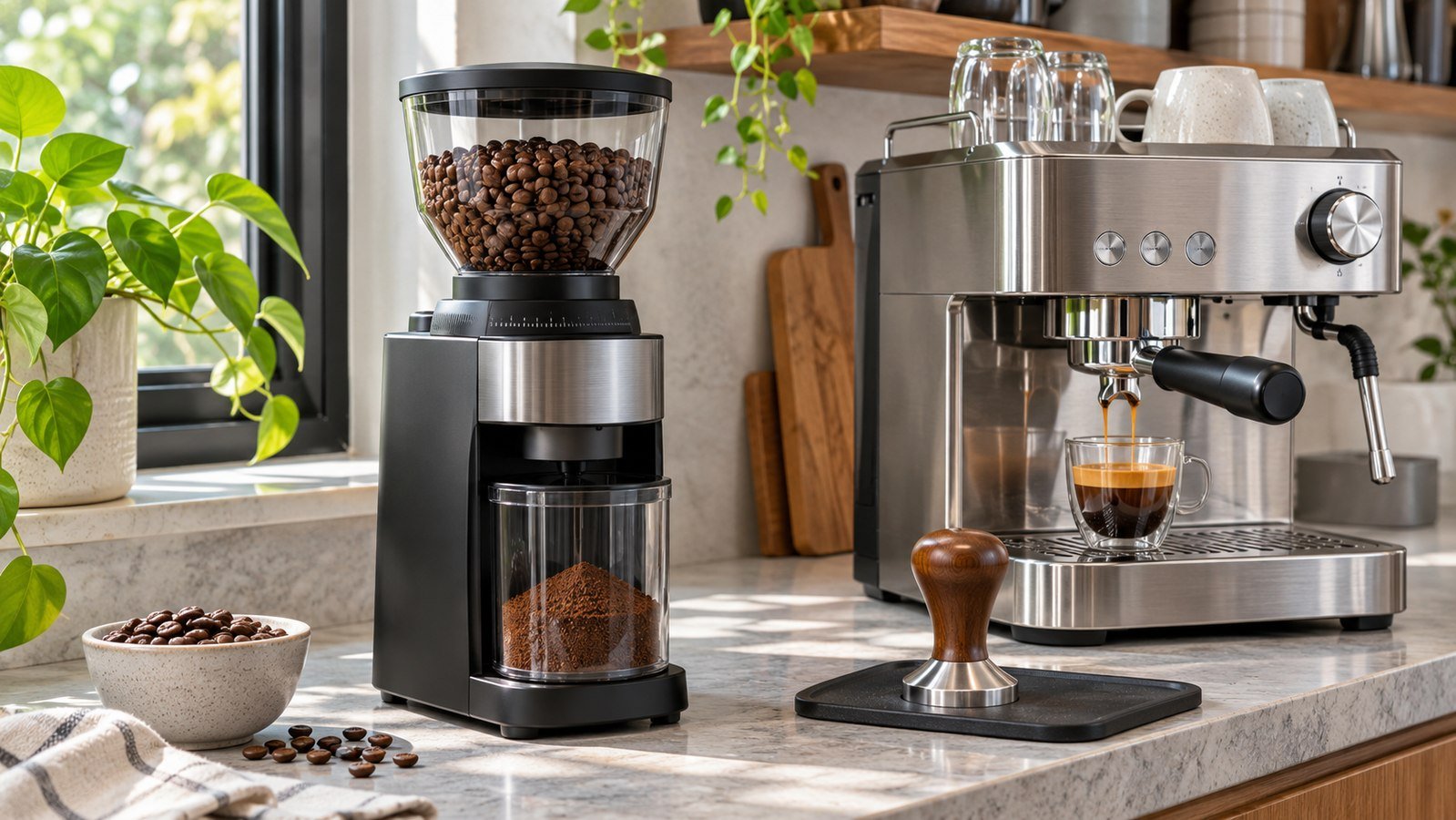
With a hopper workflow, you can keep coffee available for regular use and grind the amount you need by your preferred method. Check the height of the grinder with the hopper installed and room for its lid to open. If a machine is against the wall, look at how you reach the power switch and whether the grounds receptacle is easy to remove. A setup you can operate cleanly in a small kitchen may save work every day.
A single-dose workflow is often useful when you want to weigh individual portions and switch beans. Check whether the product is designed for that use, how the receiving cup fits, and whether you can move grounds into the basket without spilling. The difference can be mostly practical. If you share the unit with someone who wants to grind without using a scale, compare a simpler setup and the manufacturer’s dosing controls. Read the instructions for safe operation and cleaning before deciding how much daily maintenance to expect.
Make sure the basket, cup, and counter fit
Measure from the grinder’s spout to the platform or support and check the diameter of any included dosing cup. Some buyers want to grind directly into their portafilter. Others use a small cup and pour into the basket. See whether the manufacturer supplies a compatible fork or cup for the exact grinder. Model photos may show an optional item. Make a list of what comes in the box and compare a complete package rather than accessory-heavy listings alone.
For an open kitchen, consider whether the grinder will bother someone in the next room during breakfast. Published noise measures can be difficult to compare because brands use different conditions. If possible, listen to a display unit or watch recordings made in comparable conditions and use them to get a rough impression. Check the size of the bin and whether moving it leaves grounds around the base. Keeping a short cleanup routine can be more valuable than a feature you only use on special occasions.
Plan for cleaning, service, and a budget
Find the product manual and read the section on cleaning the adjustment area and burr assembly. Do not assume a grinder can be washed or taken apart in the same way as your current one. Check whether the brand provides directions for replacing commonly worn parts and whether those parts are listed in the U.S. A buyer expecting years of routine use may care more about maintenance than about another setting or peripheral accessory.
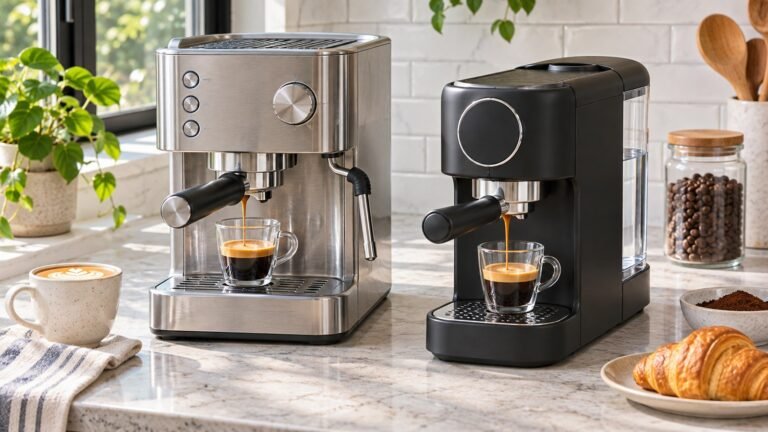
Compare the delivered price of the grinder and machine together. Our home espresso machine buying guide covers basket types and the rest of the setup. If you are deciding between those two common machines, see the Bambino vs. Stilosa comparison. Once your grinder arrives, choose one familiar coffee and learn the documented adjustment routine. Keep a note of the setting, dose, and what changed so you can tell whether the purchase makes your normal brewing easier.
Before deciding on a specific package, also price the burr or other service parts for the exact model. A simple diagram and a local parts listing can be more helpful than promises about longevity without supporting details. If you plan to buy used, ask what has already been replaced and whether the original accessories and instructions are available. Check the condition of the adjustment mechanism and note any missing pieces before comparing the final price with a new grinder. A return window and access to support can be worthwhile if you have never used that type of grinder before.
Frequently asked questions
Can a filter coffee grinder work for espresso?
Check the maker’s instructions for the grinder and your basket. A model can grind fine enough for some espresso arrangements and still lack fine enough steps for a conventional single-wall basket. Decide around the combination you intend to use.
Are more settings always better?
A few useful adjustments within an espresso range can be more relevant than a large count that mostly covers other brew methods. Look for settings you can repeat and controls you can read during the actual routine.
Is a dosing cup necessary?
That depends on how you move grounds into your basket. Some setups support direct grinding into a compatible portafilter. A cup can be convenient if you weigh portions or use baskets that do not fit well under the grinder’s spout.